Tom White

Tom White is an experienced, nationally and internationally recognized Holocaust and genocide educator having served as the Coordinator of Educational Outreach for the Cohen Center for Holocaust and Genocide Studies at Keene State College for 24 years. He is an award-winning speaker and currently serves as a Board member of the Association of Holocaust Organizations. He was named NEANH Champion of Human and Civil Rights, Peace Ambassador, Center of Peacebuilding from Bosnia and Herzegovina, and served on the NH governor’s Commission for Holocaust and Genocide Education. He served as historical consultant for the films: An American Nurse at War, Telling Their Stories: NH Holocaust Survivors Speak Out, and
HIDDEN—The Kati Preston Story.

24Nov

Beware   On a fall day in New England a friend and survivor of the Bosnian genocide turned to me and said, "Always beware of paramilitaries. That's where it starts." As I thought about how true that was across the genocides that I was studying, I thought I should add "state sanctioned". Mass atrocity crimes are facilitated by paramilitary organizations that receive the "green light" from those in power. Paramilitaries operate outside the law and avoid oversight or constraint. It is more likely to occur in places where democracy is weak or there is a state legitimacy crisis.

A History of Extra-Legal Paramilitaries   There is a long and twisted history of armed paramilitary vigilantes in the U.S. from the KKK to, according to the Southern Poverty Law Center, an estimated 169 private groups operating today. These groups exist outside state-sanctioned militias (ie: National Guard) and are often associated with anti-government and often extremist views. They find legitimacy in part by tapping into traditional symbols of contested history such as the Confederate battle flag. 

2nd Amendment    I am a New Englander. I actually look forward to Patriot's Day every April that remembers the battles of Lexington and Concord fought by minutemen militias against British tyranny. Throughout the American Revolution colonial militias were a key supplemental force for the Continental Army. At the nation's founding they had been crucial for each colony's defense. When the Second Amendment was codified, it recognized "A well regulated Militia, being necessary to the security of a free state, the right of the people to keep and bear Arms, shall not be infringed". The amendment was crucial for new states to give up some of their autonomy to agree to join and form the United States. The agreement allowed states and their governors to oversee and maintain their defense force while joining a federal state. As in any good democracy the meaning of the amendment continues to be debated. When it became part of the Constitution, smooth bore muskets were prevalent, but not the more expensive rifle. In the lasty twenty or so years the Supreme Court has increasingly ruled that individual gun ownership, with little regulation, is appropriate. Training to be a soldier in the 1980s but not taking my commission, I believe that weapons of war designed to inflict mass destruction belong in the hands of the professional national armed services. Guns continue to proliferate in our society in staggering ways that could never have been anticipated by the Founders. We continue to debate the social cost we are willing to spend. 

Compare and Contrast   As guns become more part of our daily lives one argument that doesn't hold true is the often repeated political (and marketing slogan) that the first thing the Nazis did was to take away the peoples' arms. In a false comparison, the inference is to Patriot's Day, but has little relevance to what happened in Germany. The truth is a bit more muddled and unnerving.   

The Germany Army, Paramilitaries, and Nazis    President Hindenburg named Hitler as German Chancellor in 1933 after listening to the advice of a group of anti-democratic conservate politicians who convinced him to give Hitler a chance. Since being imprisoned for treason after the failed comical Munich Putsch, Hitler wrote his fictional biography and political self-pitying rant Mein Kampf (My Struggle) in which he outlined a new political strategy. He would get power by working within the system not by trying to overthrow it. It almost didn't work, until the Great Depression, para-militarized pressure, and political back door maneuverings helped. That is where the guns come in. 

Kurt von Schleicher was a Major General in the Reichswehr (German Army after World War I). He was scheming to modernize the army by cutting social spending. He feared, with an army of only 100,000 men, that Germans would lose their identities (manliness) if they did not have mandatory military training. He was also scheming for power. In 1930, thinking that Hitler's paramilitary SA (“Brownshirts”) could fill the void, he befriended Ernst Röhm, the SA chief of staff. Schleicher gave the SA access to army depots and arsenals. The two agreed that in a crisis (war or a Communist coup) the SA would come under command of the Reichswehr. Like everyone else, Schleicher mistakenly underestimated the threat of Hitler and the Nazis and thought he could use them for his own ambitions. 

The SA were interested in antisemitism, violence, cruelty, and ending democracy. With guns now plentiful they could terrorize Hitler's opponents. It was a constant problem for Hitler. He loved the violence and intimidation tactics of the SA but was frequently put on the defensive when other leaders of society (especially the police, courts, and the Army) pushed back. In a moment of political clarity, then Chancellor Brüning was working against Schleicher and convinced Hindenburg to ban the SA and SS. To no one's surprise, street violence dropped dramatically and confidence in government stabilized briefly. It is difficult for violence and democracy to coexist. 

And then, Schleicher secretly met with Hitler on May 8, 1932. If Hitler supported him, Schleicher would convince Hindenburg to dismiss Brüning, create a new government, and lift the ban on the SA and SS (Blackshirts).  And so, Schleicher convinced Hindenburg to ask for Brüning’s resignation. A puppet of Schleicher was named chancellor and the ban on the SA and SS was lifted. Hitler would now often rally the SA to flood the streets as he tried to ramp up the pressure. His goal was to make violence the norm so that he could convince people that only he could stop it, only he could bring back "law and order". 

Warnings    Leaders in the German Weimar Republic actively worked with unregulated right-wing paramilitaries and the Army gave them weapons. There had been a long tradition of armed paramilitarism in Germany from the time of Napoleon's occupation in the 19th century through the post World War I era in the early 20th century. These military and paramilitary formations were often used to suppress revolt and keep a government (whether left or right) in power. Symbols and badges were interchangeable, such as the Death's Head symbol of the Prussian Hussars becoming the symbol of Hitler's SS. Little of this reflects the American experience whose militias were formed to protect, not destroy, communities. 

My Turn   Once when I was presenting at a U.S. military base during the Days of Remembrance of the Holocaust, a soldier asked, with obvious concern, "What is the difference between a patriot and a nationalist?" A patriot is someone who examines their country's history without fear with the goal of improving its ideals. A nationalist is someone who wants to rewrite history, exclude those who they believe do not belong, and accept violence as a means to an end. 

I'll sight only two of many obvious warning signs to the growing influence and sanctioning of extra-legal paramilitaries in the U.S.: Amongst the January 6, 2021, rioters and attackers of the Capitol were paramilitaries like the Proud Boys, Oath Keepers, Three Percenters and more, who all received presidential pardons. ICE is claiming the role of law enforcement, blurring the lines between their behavior and the police. They act outside the normal restraints and rules while well-regulated militias (professional armed services) are being coopted into the mission. Viewing pictures of German police on the parameters of SA public acts of brutality do strike a frightening, echoing chord from 1933. As a well-armed, government sanctioned and financed paramilitary, ICE has been setting up extra legal camps and disappearing people. I won't go further for now. 

Paramilitaries have skirted the law in the past and inflicted harm on U.S. citizens. President Grant established the Department of Justice to fight the KKK and succeeded, at first. It is a fine line between defense and vigilante behavior. 

When comparing ourselves to Nazi Germany it is important to point out that our system and experiences are different. Significantly, this applies to our professional armed forces. Unlike Germany, whose officers swore an oath of loyalty to the person of the Presidency, our leaders swear an oath to the Constitution. The military is designed, and its values are ingrained, to protect us from enemies foreign or domestic, and follow duly elected public officials. It is crucial to push back against those who wish to blur these lines or change the role from defense to oppression. It is alarming how much our political leadership is working to undermine and shift the mission of our armed forces. It is a troubling warning sign if militia symbols, or symbols from anti-democratic history become acceptable. 

I was alarmed this week when the U.S. Coast Guard lowered the threat level of hate symbols like the Nazi swastika, the so-called Confederate flag, and the noose. And then, I was encouraged when Admiral Lunday asserted the next day that these symbols of hate, treason, and antidemocracy would continue to be banned in the service. We are a democracy continually wrestling with its ideals and leadership matters. We need to be constantly reminded of what our democratic ideals are, support those who bravely clarify when the line is blurring. We must realize that we too are leaders standing in defense of a more just Republic not one that justifies violence for the sake of power.

Read More  
10Nov

10 November 2025 

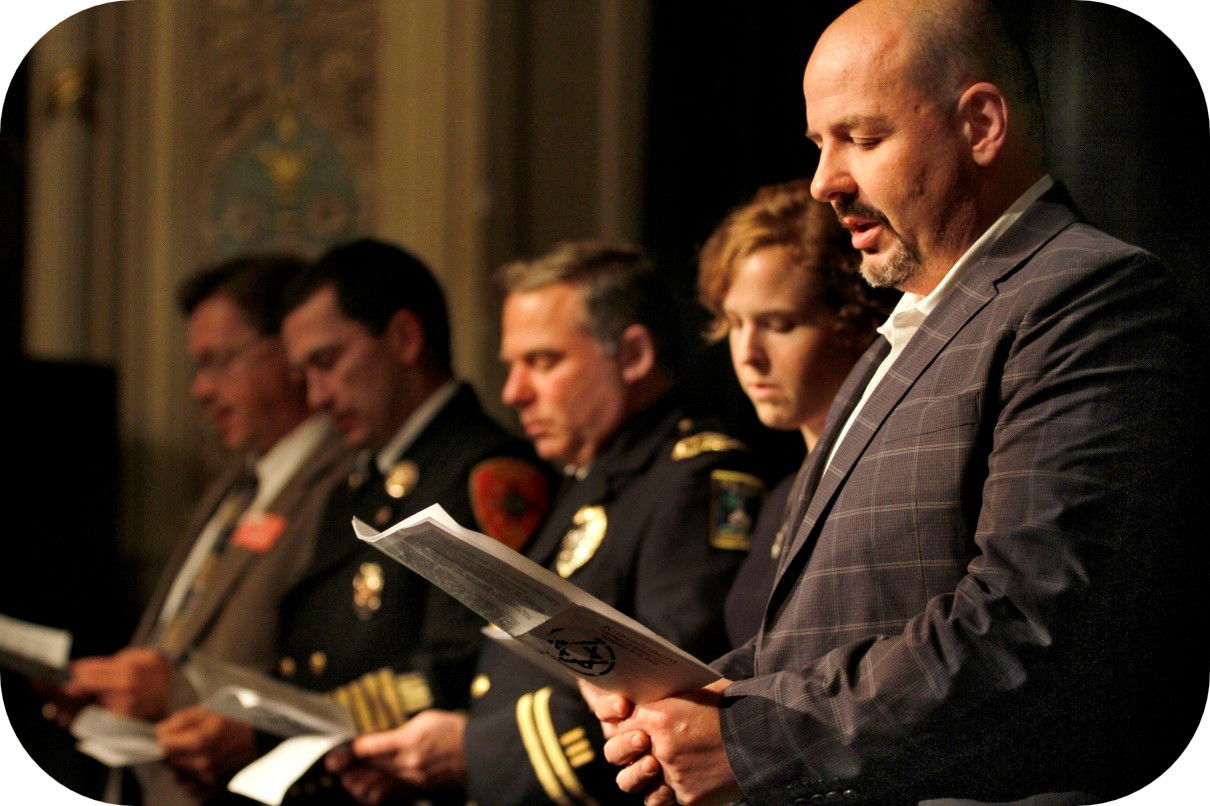
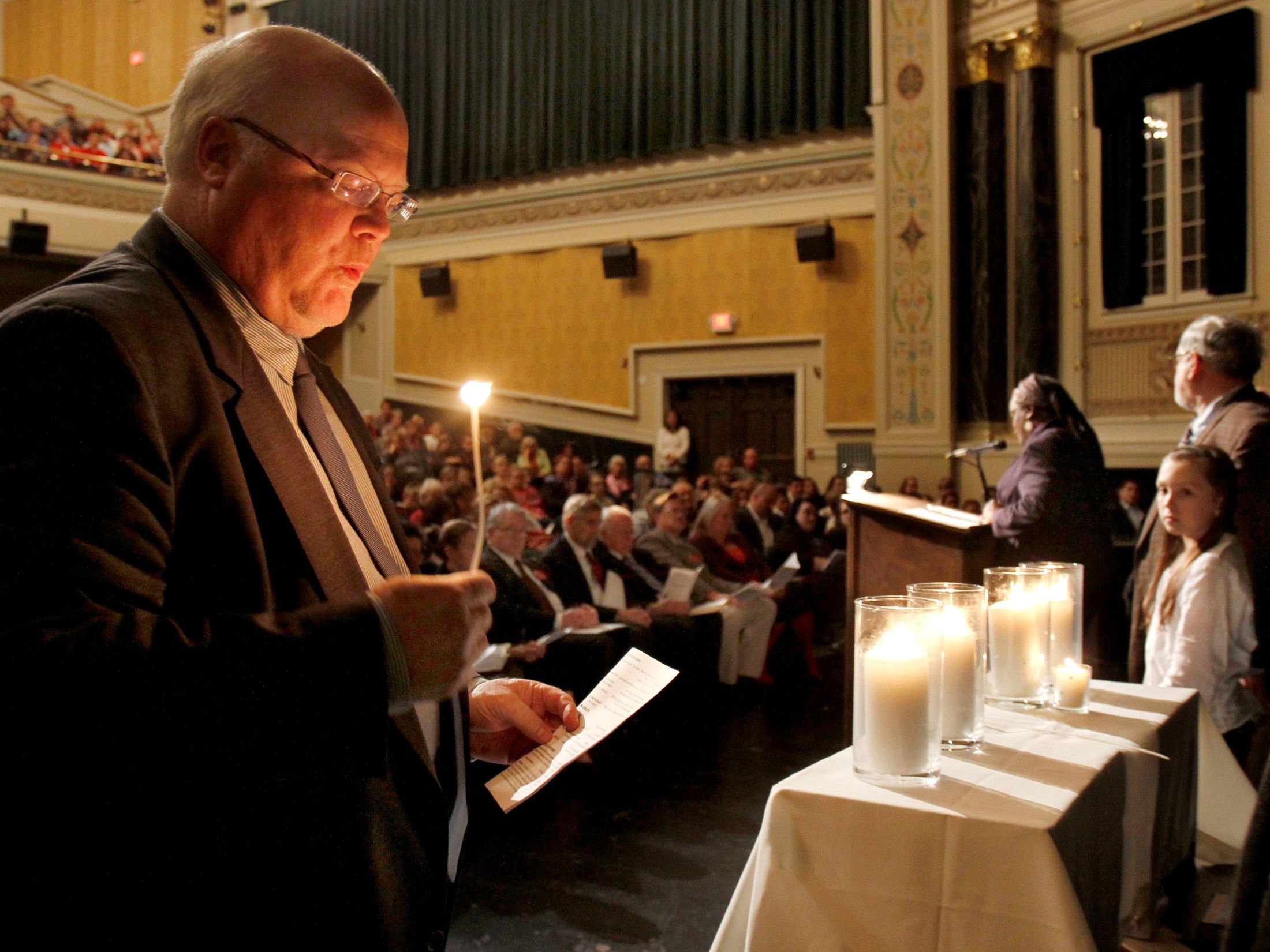
Kristallnacht Remembrance   The Nazi-organized November pogrom (violent attacks on Jewish communities with the aid or indifference of the government) took place on November 9-10. 1938. It was a threshold moment for Hitler and the Nazis who had been given power in 1933 and had destroyed checks to his power, destroyed the Weimar constitution, assumed control of the military and police, and changed German society. This evening marked a radicalizing shift in policy and actions towards Jews. Synagogues, businesses, and homes were violated and destroyed, and tens of thousands of German Jews were arrested or murdered. There were willing collaborators across society and fire and police departments stood by, generally refused to help German Jews, and hosed down adjacent buildings as synagogues and Torah scrolls burned. A new level had been reached, and anti-Jewish policy was increasingly radicalized as World War II approached. For years I helped to direct an annual Kristallnacht Remembrance in partnership with Keene NH’s Colonial Theatre to remember the violence and remind our community that mass atrocity crimes are a process not an event. By paying attention to that process, we have the power to intervene, to stop the acceleration. It was a public event that included the Jewish community, mayor, fire and police chiefs, survivors, witnesses, community organizations like MoCo Arts, school groups, interfaith community, and other community members and officials. City institutions chose to use the remembrance as an opportunity to repeat their mission of service and protection to all – in the light of a time when that was not true. Remembrance allowed us to come together, for each other, and use memory to teach responsibility and awareness. It fortified us and sustained us for many years and created a community alert to antisemitism, hate, and targeting. We are a resilient people when we take care of each other. 

Hate in the 1930s   Of the many friends Hitler had in the United States in the 1930s, I would like to focus on Fritz Kuhn and Fr. Charles Coughlin. Kuhn was a German World War I veteran who immigrated and became a US citizen in 1934. Germany had the second highest immigration quota due to the 1924 Immigration Act that gave preference to white Europeans. The act, being heralded today by some in the administration, was written and passed by members of the KKK and others who jumped on the Anti-immigrant bandwagon. The KKK’s slogan and soon to be allied movement, was “America First!”  Kuhn was a fascist, pro-Hitler, isolationist, and antisemite. He created the German American Bund on the hopes of being Hitler’s man in the U.S. and recruited mostly immigrants who were anti-Communist to his movement. At first, the Nazis offered funding but became increasingly concerned that Kuhn’s antics might draw too much attention at a time when Germany was content to let America be isolationist and ignorant. Fr. Charles Coughlin was a Catholic priest born in Canada who became a U.S. citizen. He was an antisemitic, anti-Communist, pro-Nazi, outraged radio host whose audience was the largest in American history (29 million listeners out of 130 million Americans).   His newspaper, Social Justice, had a circulation of 200,000 in 1940. He had his own paramilitary, the Christian Front militia (“Fr. Coughlin’s Brownshirts”) organized like a terrorist cell. In Boston, they showed Nazi military propaganda films. Like the Oath Keepers today, they recruit from military and police for weapons and credibility. His followers were poor and working class Irish and Germans from Northeast and Midwest. His National Union for Social Justice was a political movement focused on replacing capitalist democracy. He published the fraudulent, Russian-invented antisemitic conspiracy fantasy, The Protocols of the Elders of Zion; Nazi propaganda; Goebbels’ speeches; and praised was praised by Der Stürmer. He verbally attacked refugees as communists and Jews and ranted about the “left-wing” “liberal” media. He worked closely with the German-American Bund. His rallies were replete with American flags and crowds riled up by hatred. 

The America Frist Committee   The AFC brought together isolationists, failed Bundists, Coughlin supporters, far-right extremists, antisemites, religious bigots, the disenfranchised, and the greedy. Many respectable business leaders and politicians gave it legitimacy. They opposed the New Deal and President FDR and feared that war would undermine their European investments and markets. In September 1940 America First became an official nonprofit. They called for “Anglo-Saxon purity” and launched an antisemitic magazine, The Cross and the Flag.  

Resisting   Leaders must constantly remind us to push back against hate, anger, and fearmongering that are toxic to democracy and dignity. President FDR responded to threats and problems with caution, patience, timing, and education. He was clear about believing in democratic norms and helped to reshape American attitudes in ways that would lead to the civil rights movement. Leadership matters. But we can be leaders too. We must reject political violence, anti-democratic forces, and accept our responsibility to build a “more perfect union”. We must have confidence and courage. 

Resisting the Bund   In 1937, Kuhn’s German American Bund tried to establish a Hitler Youth-type training camp in Southbury, CT. Kuhn stated: “The principles of the Bund and the KKK are the same”. How did the people of Southbury respond? How did they meet the challenge? Rev. M. Edgar N. Lindsay was one of two pastors who used the Sunday before Thanksgiving to preach about the Nazi “menace”. The Southbury churches rallied behind their neighbors and demonstrated peacefully, and through zoning regulations, prevented a Bund camp from being built. Southbury is about 25 miles from Yale University where the America First Committee (AFC) began. 

The German American Bund Loses   In 1938 Nazi Germany cut off funding for Kuhn’s Bund and forbade membership for German citizens. Hitler was intent on keeping the U.S. isolationist. In 1939, Kuhn pulled off his greatest event, a rally in New York City’s Madison Square Garden. 22,000 attended as Nazi drums pounded and uniformed Nazis marched and gave speeches. The film of the rally is often used today as a frightening warning. However, what most people forget is that 100,000 protested outside the arena. Mayor LaGuardia was outraged by Kuhn and ordered an investigation into Bund financial records. They discover that the $14,000 raised at MSG rally had been embezzled by Kuhn and he was arrested and convicted. Other Bund leaders were jailed for various offenses and membership dwindled. After December 1941, the Bund was outlawed by the U.S. Fritz Kuhn was imprisoned for larceny and forgery from 1939 to 1943. In 1943, he was reinterned as an enemy agent. In 1945, he was deported and imprisoned in post-war Germany before dying in 1951. 

Father Coughlin Loses   Fr. Charles Coughlin ranted and justified the Nazi November 9-10 pogrom (Kristallnacht): on air by claiming they had it coming to them because Christians were being persecuted. The owner of the WMCA station that hosted Coughlin’s broadcasts immediately ended them. The Nazi German press decried his censoring as the silencing of free speech by "Jewish organizations camouflaged as American.” In 1942 the U.S. government suspended the free mailing privilege of “Social Justice” and the Archbishop of Detroit forced Coughlin to close his newspaper and forbade its distribution by mail. Coughlin vanished from the public arena, working as a parish pastor until retiring in 1966. He died in obscurity in 1979. 

My Turn   Kuhn and Coughlin were defeated because Americans took responsibility for each other and trusted in their confidence in democratic norms. We must resist the temptation to respond to hate with hate. We respond with confidence, humor, discipline, peaceful protests, and the ballot box. We find strength by recalling the destructive events that took place in the past, the people affected by them or targeted today, and we stand together. At the Cohen Center’s annual Kristallnacht Remembrances, the participants recommitted themselves to being members of a community that stands against hatred and violence. Together they would say: 

We remember that night as a moral obligation to the victims and the survivors as well as for ourselves, for the sake of our children, and for our community. We recognize our responsibility to care for others in our midst who might be overlooked, targeted, or victimized in their circumstances. We remember so that                individuals may refuse to become perpetrators, “bystanders” or   collaborators. We remember in the hope that present and future   generations take responsibility for building a world free of   antisemitism, bigotry, intolerance, and hate. Therefore, we     remember Kristallnacht to remind ourselves to care for one another, to build peace, and be a community in which compassion, respect and justice thrive.

On this Veteran's Day, let us also remember the sacrifice of our veterans who risked all to defend the idea of liberty, freedom, and dignity. 

Read More