Public and Leadership Presentations
Democratic Resilience vs. Fascist Fear: Facing Challenges in an Imperfect Republic (1930s-1940s)
How did FDR’s “missionary generation” respond to the threat of anti-democratic (and even Nazi) leaders at home and Nazism abroad? Facing the appeal of totalitarian solutions, disintegration and decay of democratic politics, economic stress Americans, through FDR’s leadership, discovered effective and timely solutions. Why is antisemitism a threat to all? Why do people choose to hate? What is the difference between democracy and fascism? How does a difficult past help us find resilience in the struggle to preserve democracy? This presentation reminds us of the power of democracy, its ability to reject extremes, and how to effectively respond to totalitarianism.
Building Resilience through Leadership (Professional Organizations)
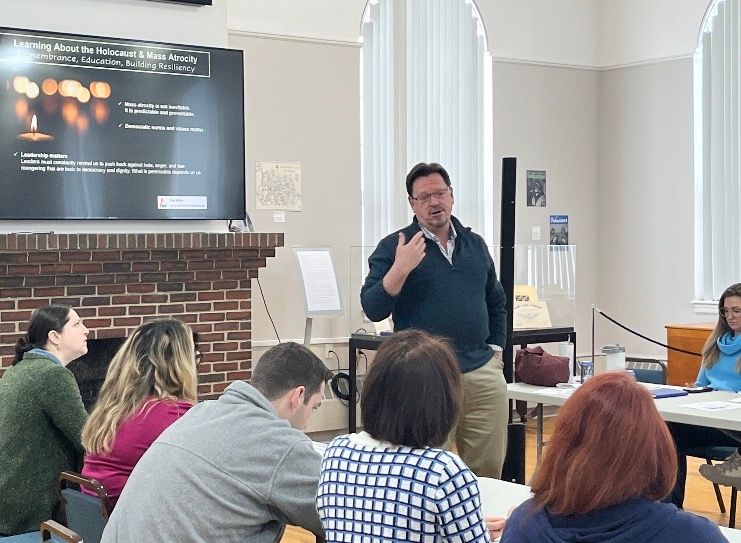
Leaders must constantly remind us to push back against hate, anger, and fearmongering that are toxic to democracy and dignity. What is permissible depends on us. How does exploring bias, hate, antisemitism, and mass atrocities like the Holocaust help us in our personal and professional lives? How do stories of survivors and witnesses help us navigate our lives, shape our decisions, and create more effective workplaces?
This presentation offers guiding thoughts on how to frame discussion and create safe space for differing points of view. We will learn the power of facing difficult history, the power of bias and manipulation, the importance of social identities, and identify how the processes of exclusion and targeting work. By facing difficult history, we reinforce democratic values and norms while building resilience.
Building Your Own Resilience by Facing Difficult History (Schools)
Hate has nothing to do with the target group but emerges from the needs of those who decide to target people. Hate is destructive and self-destructive because when one hate rises they all do. It erodes freedom and limits choices. So, who tells you to hate, and why? How does bias work? How can we recognize hate and resist and overcome it in our own lives? Using personal stories from my years as a Holocaust and genocide educator we will discover how survivors and witnesses help us discover our own strengths to identity and resist hate. What is permissible is up to us. Stories I will use include: Hannah Pick, Anne Frank’s friend; Kati Preston, hidden child from the Holocaust; Ernie Michel, Holocaust survivor; Martin Rumscheidt, son of a Nazi perpetrator; Vahidin Omanovic, Bosnian genocide survivor; Patrick Smith, UN officer awarded the Nobel Prize; and Stephan Lewy, Holocaust survivor and U.S. intelligence officer.
Eugenics: Bigotry Disguised as Biology
Eugenics was a 19th-20th century movement to purify and strengthen the white race. It grew in the intellectual circles of countries such as the United Kingdom and Germany that were determined to deal with an “enemy” (socially and racially) from within. How did this race-based, elitist, antidemocratic, and antisemitic ideology become a mainstream idea in popular culture, politics, and law in the United States? What were the connections to and differences between American eugenic and Nazi German “race hygiene” practices? How did American ideas about race influence Nazi German thinkers?
This presentation will explore to what degree Nazi race law, marriage law, forced sterilization, the Nuremberg Laws, and other “race hygiene” practices were informed by eugenic ideas and American precedents such as Jim Crow. Although Americans began to reject eugenics in the 1930s and the ideology was debunked as bad science, what lingering effects does it still have today?
How does confronting the difficult history of eugenics help us confront the threat of racism and white supremacy without using labels to isolate and radicalize those who think hate is the answer?