Holocaust Classroom Presentations (High School and Public)
1. Antisemitism: When One Hate Rises, They All Do
Studying hate will tell us little about the group being targeted, but much about the destructive and self-destructive motives of perpetrators. How do we identify, resist, and respond to antisemitism, racism, and other hatreds? We will explore what it means to embrace democratic values and norms as a tool of resistance and resilience. Rather than assign labels, we will explore models of appropriate responses and our obligation to reject anti-democratic and hate-driven behavior.
2. Antisemitisms: Hatred as Identity
Antisemitism is a dynamic and durable force of hate. It is toxic to democracy and potentially lethal to its targets - especially when expressed as conspiracy fantasies. This presentation explores the origins of antisemitism. We will trace the development of antisemitic ideas from its Christian roots of anti-Judaism to modern antisemitism. We will wrestle with current manifestations of antisemitism from Nazi Germany to the QAnon conspiracy fantasies, recognizing that when one hate rises, they all do.
3. QAnon Conspiracy Fraud
QAnon emerged in 2017 and has gone from being a fringe conspiracy to one embraced by political leaders. It is straight out of The Protocols of the Elders of Zion and shows the antisemitic threat to all of us. What are the characteristics of conspiracy thinking? How do we recognize and respond to the threat and talk to somebody who embraces it?
4. Traveling and Studying in Israel
This presentation developed from trips to Israel and will serve as a fun travelogue illustrating the geography, culture, and history of Israel. Particular focus will be given to the Old City of Jerusalem as well as Jewish, Christian and Muslim holy sites. Additionally, we will visit the landscapes of the Galilee, Masada, the Dead Sea, as well as the Jordanian and Lebanese borders. The presentation will end by highlighting the work and mission of Yad Vashem.
5. Heeding the Warning Signs: Antecedents and Precursors to the Holocaust
Did you know the Nazis chose to hate many groups of people? They started with black Germans (“Rhineland bastards”), homosexuals, “social criminals”, inferior “races”, and Jews. How did the Nazi white nationalist supremacist movement gain support? How do we identify these anti-democratic processes of targeted hate that feed authoritarianism and threaten a society’s freedom and safety?
6. Strongmen: Authoritarian and Fascist Leaders
Strongman emerge in times of perceived crisis (times of change, trauma, and perceived threats to “masculinity”) and utilize violence, misogyny, and attacks on truth to gain power and bludgeon democracy. Facing the growth of anti-democratic movements, white supremacy, and would-be strongmen authoritarians, how do we perceive, identify, and confront the threat with the values of American democracy?
7. Rise of the Nazis: The Plot to Destroy Democracy (1919-1933)
Hitler was an ongoing failure, until he wasn’t. How did Hitler come to power with the help of a small group of anti-democratic, conservative and nationalist politicians and aristocrats? Once Hitler was named chancellor he and his collaborators dismantled the Weimar Republic within five months.
8. Destroying Democracy from Within: Failure and Limits of Democratic Institutions (1933-1938)
There was no guarantee that Hitler and the Nazis would keep power. Within the first five months they were able to destroy the checks and balances and create a police and terror state. Why did people overcame their general sense of unease to help the Nazis destroy democracy? How did mass atrocity not only became possible, but permissible?
9. Purity, Eugenics, and Lethal Medicine
How did an elitist, antidemocratic, race-based, antisemitic ideology became popular and get implemented in the U.S. before Hitler came to power in Germany? What are the connections to and differences between American and Nazi German racism and eugenics practices? How can eugenics history help to confront the threat of racism and white supremacy?
10. The United States and the Ongoing Challenge of Nazism and Nazi Germany
How did President FDR confront the threat of Nazi Germany in a U.S. facing economic strife, isolationism, the KKK, and Jim Crow racism? We will explore American racism and how policy decisions were made in the context of the unfolding events between 1933 and 1938. How does the past help us find resilience in the struggle to preserve democracy?
11. Democratic Resilience vs. Fascist Fear: Facing the Challenge of Fascism in an Imperfect Republic (1930s-1940s)
Exploring democratic resilience in the face of fascist fear. How did FDR’s “missionary generation” respond to the threat of anti-democratic (and even Nazi) leaders at home and Nazism abroad. Why is antisemitism a threat to all? How did American democracy confront and reject the appeal of totalitarian solutions and fascist supporters at home in the 1930s?
12. Learning from the Past: Facing Difficult History in the U.S. and Germany
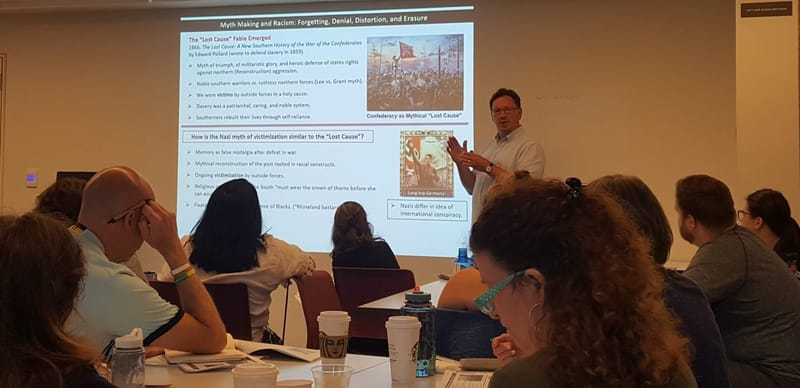
What do cultures of defeat (the Confederacy and post WW I German society) have in common? We will explore the second Civil War (the War against Reconstruction) and how its ideology of racism has influenced the American experience. How does German encounter with its Nazi past help Americans confront their difficult history of slavery?
13. Elie Wiesel: Profound Trauma, Remembrance and Hope
How and why does a survivor write about the Holocaust? How is Night constructed and why? How dies its confrontation with the Holocaust act as a starting point of wrestling and healing? What can it teach us about Jewish life and our own power to be resilient and reject despair?
14. Anne Frank – To Be Free, to Be Myself
How do we remember Anne and those hiding in the Secret Annex and why? How can Anne’s diary, story, and voice become, as she hoped, “useful” in helping our students discover their voice and face the challenges of today? Special attention is given to the memories of Hannah (Goslar) Pick, Anne’s childhood friend (whose January 2007 Yad Vashem interview will be used).
15. Civil Society Between Darkness and Light: Danish Resistance and Rescue (1940-1946)
An exploration of the German occupation of Denmark, the Danish Resistance, the rescue operation to Sweden, and the postwar reintegration of Jewish refugees. A particular focus will be on the fishing village of Gilleleje and those rescued and others captured and sent to Theresienstadt. Two child survivor testimonies recorded in October 2015 (Ole Philpson and Tove Udshott) will be utilized. By examining Denmark’s unique experience and its testament to civil society before, during, and after the Holocaust, we raise questions about how to improve civic responsibility and build stronger democracies.
16. France Under Nazi Occupation: Memory, Myth, and Misogyny
Exploring the traumatic history of France during World War II, this presentation explores collaboration, the Holocaust, resistance, and memory. How does memory continue to be a battleground between the right and the left? How do gender definitions shape interpretations of the past? Why did a greater percentage of French Jews survive the Holocaust? How does this examination of a difficult past help us to confront our own difficult and traumatic history?
17. The Holocaust: The Twisted Road to Auschwitz
How did Nazi policy accelerate and adapt over time in the complex face of changing political, military, and social circumstances? Specific attention will be placed upon the Nazi racial laboratory of Poland 1939-1940 and the escalating processes and individual decisions that led to the “final solution”. (For advanced classes.)
18. Treblinka: Evolution of a Killing Center
Operation Reinhard killing camps (Bełżec, Sobibor, Treblinka) operated from 1942-1943 and murdered an estimated 1.7 million people. There were less than 150 survivors. This presentation seeks to focus attention on the deadliest phase of the “Final Solution” by exploring the development of Treblinka and the killing processes that took place there. Who were the organizers and perpetrators? How did the prisoner uprising of 1943 help to close the camp? (For advanced classes.)
19. The Power of Place: Encountering Auschwitz
How does one encounter the killing site of Auschwitz? What can we learn? How and what do we "remember"? Based upon visiting Auschwitz I and II in November 2014 with the Auschwitz Institute for Peace and Reconciliation (AIPR) this presentation explores how ordinary people commit extraordinary evil. Weaving together archival images from a project by two Nazi photographers from the lab/identification service project in Auschwitz with photographs from the 2014 trip, we will explore the process of genocide and the "moral universe" the perpetrators created. We will explore the deliberate structures created to serve the needs of the SS, architects and businessmen in exploiting and destroying human beings. We will explore the challenges of encountering such a place, make room for mourning, refusing to normalize our outrage, and ask, "Where do we go from here?"