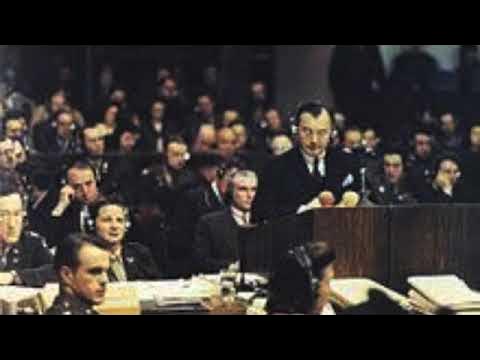
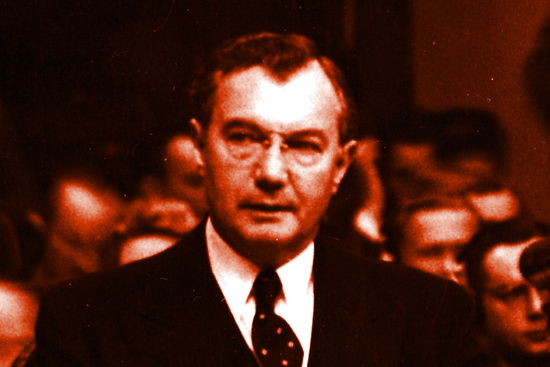
The Nuremberg Trials: Selective Judgement
The film Nuremberg has made viewers question and reflect on how a democracy descended into fascism. What sorts of personalities and decision-making shape the violence? Simultaneously we are confronted with potential war crimes by our own Department of Defense with indiscriminatory attacks on boats in the Caribbean and the follow-up killing of the survivors. The media has tried to bring our attention to military ethics and codes of conduct that are under assault by using the cases of Nazi U-852 commander Heinz-Wilhelm Eck who was executed for the war crime of gunning down survivors of a freighter n 1944; U.S. Lieutenant William Calley’s conviction of murder for the Mi Lai massacre of 1968, and the crimes committed by U.S. soldiers at Abu Ghraib prison in 2003. “I was only following orders” is not a defense. Law and ethics are the guardrails of functioning democracies. Murder is a crime, but is mass murder different? Raphael Lemkin was a student at the University of Lwów Law School in post-World War I Poland. He was disturbed by the Armenian genocide that was in the news in 1921 because one traumatized survivor, Soghomon Tehlirian, was on trial for assassinating Talaat Pasha, the former Grand Vizier of the Ottoman Empire. Why was he on trial while Pasha, who was convicted in absentia and sentenced to death in the Turkish courts-martial of 1919–20 lived freely in Berlin under an assumed name? Tehlirian was acquitted on grounds of temporary insanity after a brief two-day trial. In 1926 Symon Petliura, alleged overseer of a Ukrainian pogrom in 1918, was killed in Paris by traumatized survivor Shalom Schwarzbard. Like Tehlirian, he was acquitted on the grounds of temporary insanity. Why were individuals forced to take the law into their own hands? Because at the time there were few international laws to punish mass atrocity. States could do what they wished to do to anyone within their borders. Why? State Sovereignty The 1648 Treaty of Westphalia ended the Christian internecine devastation of the Thirty Years’ War. The treaty established the concept of state sovereignty, that the state has supreme, exclusive authority over its territory and domestic affairs. This would create an international system of states meant to maintain order through a balance of power and through avoiding religious wars. This was one of the guiding concepts in both our Declaration of Independence and Constitution. The First Amendment, adding the idea of individual rights of citizens, created the foundation principle of freedom of speech to prevent laws “respecting an establishment of religion or prohibiting the free exercise thereof.” Can States Legally Commit Atrocities? When Lemkin asked his professor Juliusz Makarewicz about his dilemma about Tehlirian and Tallat Pasha he responded, “Consider the case of the farmer who owns a flock of chickens… He kills them and this is his business. If you interfere, you are trespassing.” Makarewicz was a Polish nationalist who resented the 1919 Minorities Treaty of the Treaty of Versailles that singled out Poland for its attack on minorities, especially Jews, after the First World War. He was arguing that states had the right to protect themselves (or their perception of national identity) when, as he saw it, it was being threatened. He was arguing state sovereignty. Nuremberg Trials In 1945 Justice Jackson opened the trial of top Nazis by stating, “The wrongs which we seek to condemn and punish have been so calculated, so malignant, and so devastating, that civilization cannot tolerate their being ignored, because it cannot survive their being repeated.” But what crime would Nazis be tried for? It was decided to charge them with war crimes and crimes against humanity. War crimes (based on the Lieber Code of the Union Army in 1863 and Hague Conventions of 1899 and 1907) are defined as acts between sovereign states in war/armed conflict violating the laws or customs of war (murder, killing civilians, child soldiers, destruction without military necessity…) Crimes Against Humanity (1945 Nuremberg and UN Charter) are defined as “Murder, extermination, enslavement, deprivation, or any other inhuman act committed against an entire civilian population before or during the war, or persecution for political, racial, or religious reasons.” In other words, crimes directed against any civilian or an identifiable part of a civilian population in war or peacetime. The trials would judge individual actions committed outside of Germany that violated other nations’ sovereignty. Were no crimes committed in Germany from 1933-1939? Genocide Since 1933 Lemkin had tried to give a name to intentional mass murder. By 1944 he had combine the Greek “geno” (race/tribe) with the Latin “cide” (murder). The 1948 U.N. Convention for the Prevention and Punishment of the Crime of Genocide (ratified in 1951) promised to “prevent and punish” genocide. The new legal concept was meant to be preventative: to identify escalating processes of targeting groups (even within sovereign states), to identify and project intent, and to stop it before the killing began. We will discuss this later. My Turn We are about to judge if our Department of Defense has committed war crimes or just straight out murder because we “cannot tolerate their being ignored.” Justice Jackson continued his introductory remarks by observing, “That four great nations, flushed with victory and stung with injury stay the hand of vengeance and voluntarily submit their captive enemies to the judgment of the law is one of the most significant tributes that Power has ever paid to reason.” We are being challenged to stand up for our ideals and the rights of citizens against unchecked power. It is truly patriotic to ask difficult questions of those in power and of ourselves. We remember that our government speaks for us, We the People. Legal standards, restraint, responsibility for and dignity to others, not their exploitation or destruction, is the work of democracy. I am the historian on the film Hidden: The Kati Preston Story about a child who survived the Holocaust by being hidden from the Hungarian police working with the Nazis to deport her to Auschwitz. Using the Nuremberg Trials as a guide, one could argue that Germans committed crimes in Hungary, but did Hungarians? This is important because if we do not confront our own national histories we can likely twist them in ways that undermine democratic protections.