Season 2, Episode 17: Democracy Over Religious Bigotry

Listen Here:
The past few weeks I've been presenting to middle schools in NH and zooming in to towns in Canada for audience discussion after the viewing of our film, Hidden: The Kati Preston Story. From middle school students to adults the questions and concerns are the same. What do we do to face the threats to our democratic way of life that are coming from within? What’s at stake if we don’t? A starting point is to ask, “Who tells you to hate and why?”
Our Democratic Way of Life Under Assault By now, it’s obvious to most that we're witnessing undisguised corruption, fraud, incompetence, racism, religious bigotry, venality, and use of the American government to accelerate the plundering of our people to increase access to, and the wealth of, the president and his family. They aren’t even trying to hide it anymore. As he and his sycophants grab billions, the world economy teeters, foreign policy is wrecked, global insecurity grows along with the threats of potential famines, many are dying or being killed. Government institutions are hollowed out, corrupted, and purged, while Americans lose more and more. In these circumstances hate also rises and is manipulated and used by those wishing to stay in power. It's a bleak time, and many are confused and fearful. And yet, education continues to point the way forward.
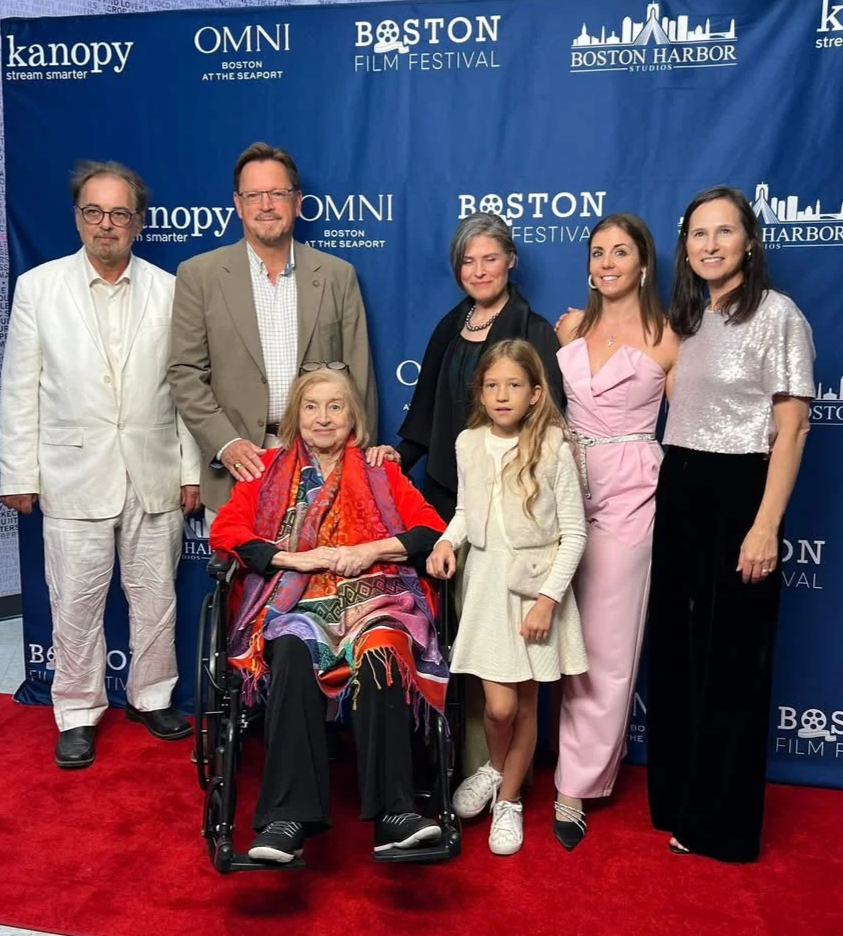
Canada It may be news to learn that Canada is facing rising antisemitism and the targeting of Jews. Jewish friends feel threatened, some of their children are attacked, and some stores refuse to sell food for Jewish holidays. Fear is on the rise. And yet, as we’ve shown Hidden, we’ve discovered engaged and enthusiastic audiences in sold out theaters who want to learn from Kati's story and stand up for their neighbors. The film is received warmly and I’ve been fortunate to zoom in with Kati Preston, the survivor whom the film is focused on.
Questions We’ve been asked things ranging from “Did you sneeze while hiding in the hay” to “how do I do more than be a sheep watching things happen”? It doesn’t take long to realize that people are energized and know what’s at stake. They’re seeking ways forward that don’t betray their beliefs. There's urgency.
Being together and showing up for the film is a great first step. It’s important to make sure targeted groups do not feel alone and to recognize that when one hate rises, they all do. When any group is targeted (predictably, LGBTQI+, immigrants, and on and on…) we must recognize the threat to all of us. Antisemitism is usually the canary in the mine warning us that we might be next.
As Christian nationalism has been used to justify hate and vilify the other, it’s a good reminder that Christian scripture and Jesus actually warns about the targeting of others in Matthew 25:45: ‘Truly I tell you, whatever you did not do for one of the least of these, you did not do for me.’
Christian, Jew, Muslim, or secular we must take care of each other.
Courage in Conviction I continue to believe in the dignity and promise of democracy. We’re in a very rough sea but we can fight back against the storm. As politicians try to narrow our identities and reduce the scope of who matters and who belongs, we must be reminded that we were not founded as a Christian nation – but a nation that would protect the right to practice Christianity and whatever faith tradition guides you. Evangelical Christians, for example, make up about 13% of America’s Christians. Their right to practice their faith must not be infringed precisely because the First Amendment protects all of our rights to free expression and liberty. Our national experiment would not be haunted by the bloodbaths of religious wars of identity in Europe (Thirty Years' War) or by religious intolerance. It wouldn't matter what faith you did or didn’t have but whether you were loyal to the ideals of the Republic and the values of democratic life that provided the liberty to do so.
"To bigotry no sanction, to persecution no assistance" In 1790 The Jewish Congregation of Newport, Rhode Island were frightened that our newly formed Republic would identify only as a Christian nation and that religious persecution and antisemitism would start up here as it had in the Europe many had fled from. Would the federal government guarantee equal rights, safety, and religious liberty or merely talk about “tolerance”? After all, Jews and religious minorities still couldn't vote in the generally tolerant Rhode Island. They wrote a letter to George Washington asking for reassurance.
Washington responded immediately. It's important to realize what he wrote and to accept the challenging responsibility he modeled:
“It is now no more that toleration is spoken of as if it were the indulgence of one class of people that another enjoyed the exercise of their inherent natural rights, for, happily, the Government of the United States, which gives to bigotry no sanction, to persecution no assistance, requires only that they who live under its protection should demean themselves as good citizens in giving it on all occasions their effectual support. May the children of the stock of Abraham who dwell in this land continue to merit and enjoy the good will of the other inhabitants—while everyone shall sit in safety under his own vine and fig tree and there shall be none to make him afraid."

Who Tells You to Hate? I ask middle schoolers to tell me what hate looks like to them and then to identify the sources of hate. They talk about “casual cruelty”, a great term to describe the little, everyday things we do to each other that don’t necessarily bother us. When we discuss who tells you to hate the answers range from friends and family to the internet. They conclude that someone wants you to hate because they want to take away your power. When you embrace hate your world shrinks, your allies and options are fewer, you become more easily manipulated by those who wish to turn people against each other. Who promotes hatred on line? Putin, the KKK, neo-Nazis, white supremacists, dictators and tyrants. Turning people against diversity makes us all weaker – and they know it. We don't have to let them have power over us.
The Forrest or the Tree? In my part of town they've just cut down all the red pine trees because they caught a disease and became a potential hazard. Interestingly, the other variety of trees around them are doing just fine, thank you.
Below: Dinsmoor Woods, Keene, NH.

The point? If we reduce ourselves to being only one type of tree, we're susceptible to a disease and may die. If our forest has many thriving varieties, we are more capable of resisting diseases that harm. In diversity there is strength and resilience. It’s a good metaphor about democracy and hate.
My Turn It’s been one of my personal and professional joys to work with Jody Glover, Daniel Matmor and others in their production of the film Hidden. Kati, the survivor, is a dear friend, education companion, and guide. Survivors hear and see the echoes and continue to fight back.
Kati was hidden as a child in Hungary as the Nazis and their collaborators engaged in one last orgy of murder in the summer and fall of 1944. Most of her family, including her father, were murdered in Auschwitz. Only she and her mother survived. She survived because of the courage of Elizabeth, a peasant girl, who hid and shielded her. The movie shows the quick escalation of the Holocaust in Hungary and also the postwar indoctrination into Communism. Hitler and Stalin illustrate the dangers of the cult of the leader.
We’re once again facing the cult of the leader and religion being used as a weapon. It’s predicated on hate, fear, cynically turning us against each other so that the leader exploits us for his own personal gain. However tempting it is to hate – including hating what this small minority of zealots are doing to us – we must resist. Hate is not the way forward nor is “tolerance”. All tolerance means (and Washington was quick to point this out) is that I, the one in power, grant you the right to exist. I “tolerate” you. Nope, we must do better. Our country is grounded in the Bill of Rights. We're citizens not subjects.
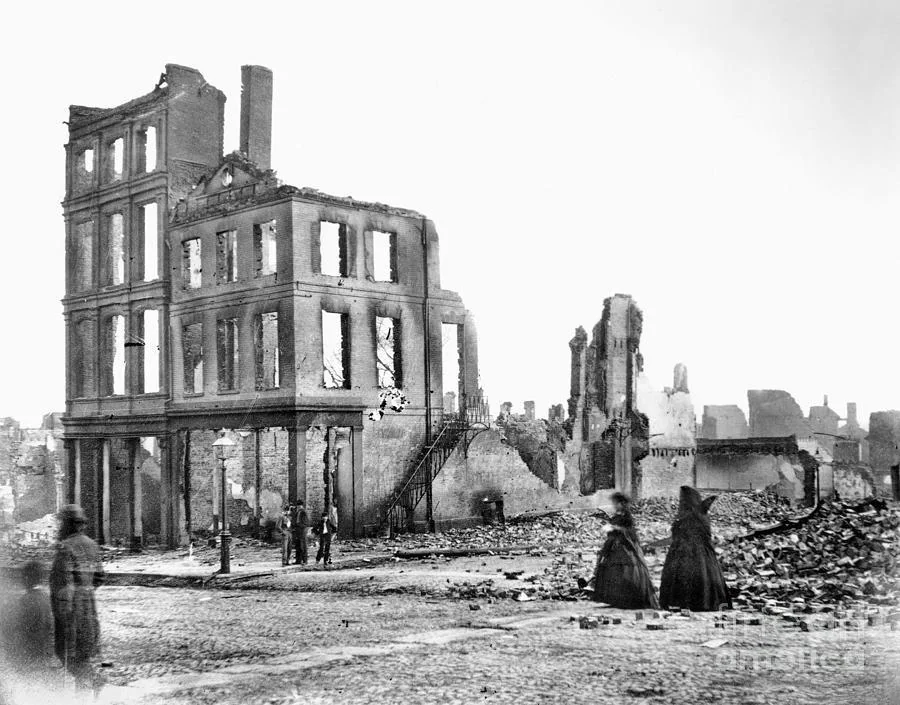
Above: Richmond, VA, 1865.
Recognizing that the hater seeks destruction and your own self-destruction (a quick comparison of Richmond, VA in 1865 and Berlin, Germany in 1945 illustrates this) we must turn our backs on hate.
Turning Our Backs on Hate And so, I’ll end by sharing the story of Ernie Michel, Auschwitz #704995. Ernie was the only German language reporter of the postwar Nuremberg Trials. Ernie wrote his byline only as “704995”. Göring read his work to learn about the trial and was so impressed by the articles that he invited 704995 to his cell to meet him in a show of tolerance. When Ernie arrived, he saw a very personable Göring reaching out his hand. Göring knew what the number meant, but it didn’t matter to him.
I assured Ernie at this point that he could tell me anything. If he kicked, spat on, or slugged Göring, I’d be ok with that. I wanted him to tell me he got some sort of justice. But the survivor taught me a life lesson. He could have done all of that and more and been justified in doing so. No one would have questioned his right. Instead, he got his revenge another way. He remembers asking himself, "What am I doing here?" and then he said, “I turned my back on Hermann Göring?!” He repeated it again with a look that combined glee with painful courage. I still remember him squaring his shoulders in pride. You see, he was telling me that he decided to stop being identified only as a victim. He couldn't justify any more violence. His revenge was to chose life and freedom. He chose to be a survivor.
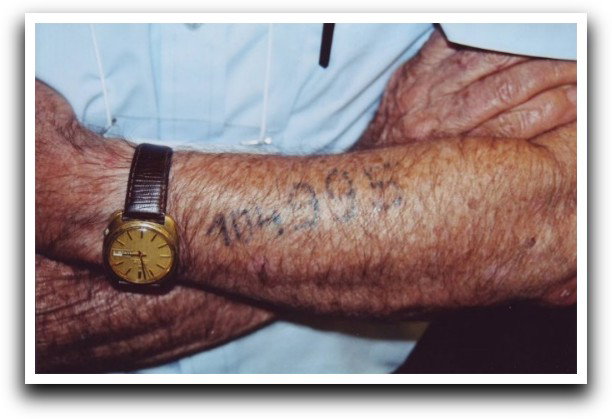
Ernie walked away from Göring, literally turning his back on hate. Göring's hate had given him power, destroyed many people, but had left him reduced to a cold prison cell awaiting execution. Ernie walked into the world as a man walking away from victimhood.
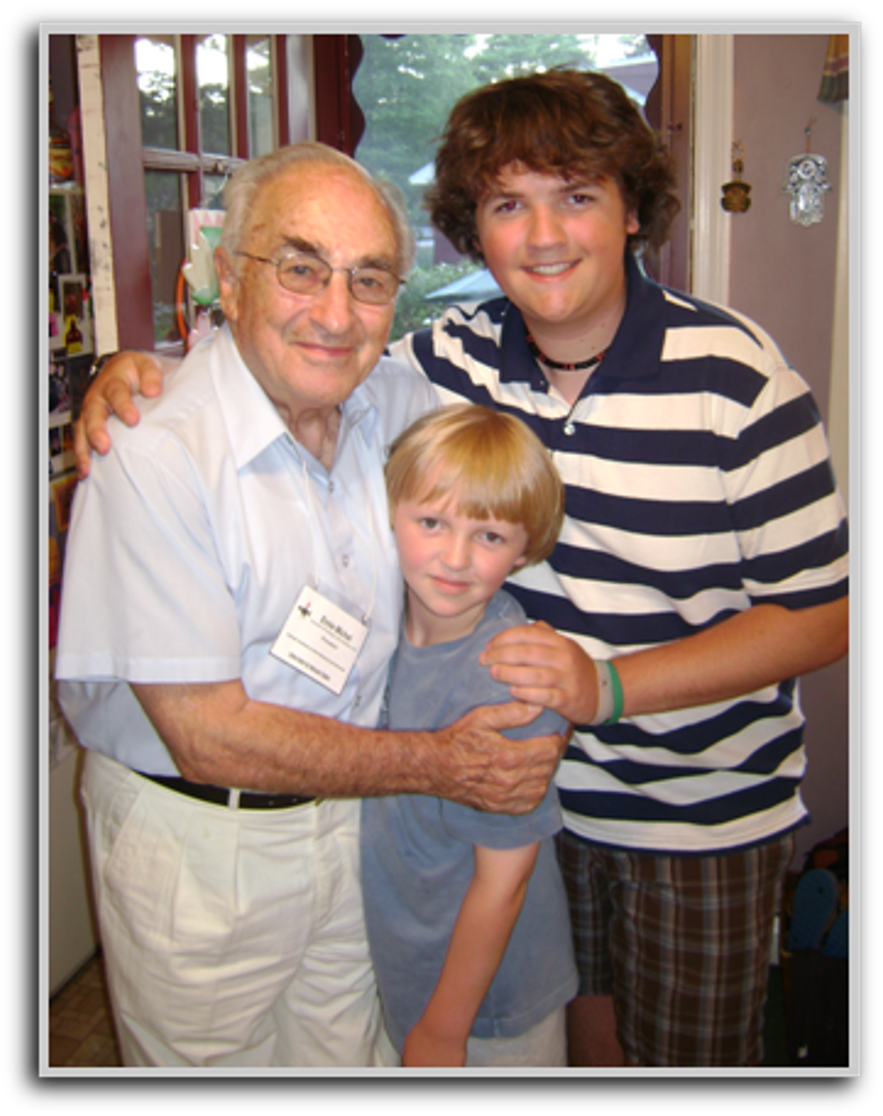
Ernie lived a long and wonderful life and organized the first reunion of Holocaust survivors. Being together mattered. My children saw his number.
Victimhood and Survivor It's never easy or simple. One is neither one or the other. But if we can fight back against victimhood we can fight back against hate. I learned that leaders stoke our hate by claiming that they and you are victims. It’s the easiest way to justify hate and open the path to becoming a perpetrator. Instead, we can choose another path forward and walk away from the prison of hate.
If survivors could rebuild and offer us their knowledge and guidance we can listen. We can't despair while facing the cult of leadership that uses religion to sow hate and division. 250 years ago we created a Republic where the hope of human dignity could replace the tyranny of kings. We must embrace the challenge with sober confidence.
Below: Ernie with my two sons.