Law and Order or Law by Order?
Hyperbole? In January 2016 Presidential candidate Donald Trump stated, “I Could ... Shoot Somebody, And I Wouldn't Lose Any Voters”. According to the Washington Post this week, Secretary of Defense Hegseth ordered the military to “kill everyone” who had survived an attack on an alleged drug smuggling boat. This, after firing many top JAG lawyers and after announcing to top U.S. military leaders forcibly assembled at Quantico in September 2025 that the U.S. would no longer be bound by the military rules of engagement. Are we about to cross the line into being a lawless nation running at the whim of its leaders? Are we to discard the Declaration of Independence and the Constitution and let violence overcome legal constraint? Hyperbole you say? It is astonishing that this is the actual opening of a blog in the U.S. in 2025. We are entering the next phase to test the strength of Madisonian checks and balances democracy. I believe we will pass this test. It is important to point out, however, that Germans did not in the 1930s.
Hitler Given Power Hitler is given power legally In 1923 while in prison for treason (trying to overthrow the government with a coup) Hitler wrote his whiny, self-pitying, hate rant Mein Kampf (My Struggle) that not only invented a false political biography but shifted his political calculations. Rather than seize power he would get it by working within the system, by getting the Nazi Party to win elections. Then he would be able to destroy the state from within. Hitler went from defeat in November 1932 to being named chancellor by a willing coalition of conservatives in a few weeks in the beginning of 1933. President Hindenburg, convinced by backroom plotting by self-serving elites, had given Hitler power legally. It did not take him long to overcome the checks and balances of the Weimar Republic and establish his destructive dictatorship.
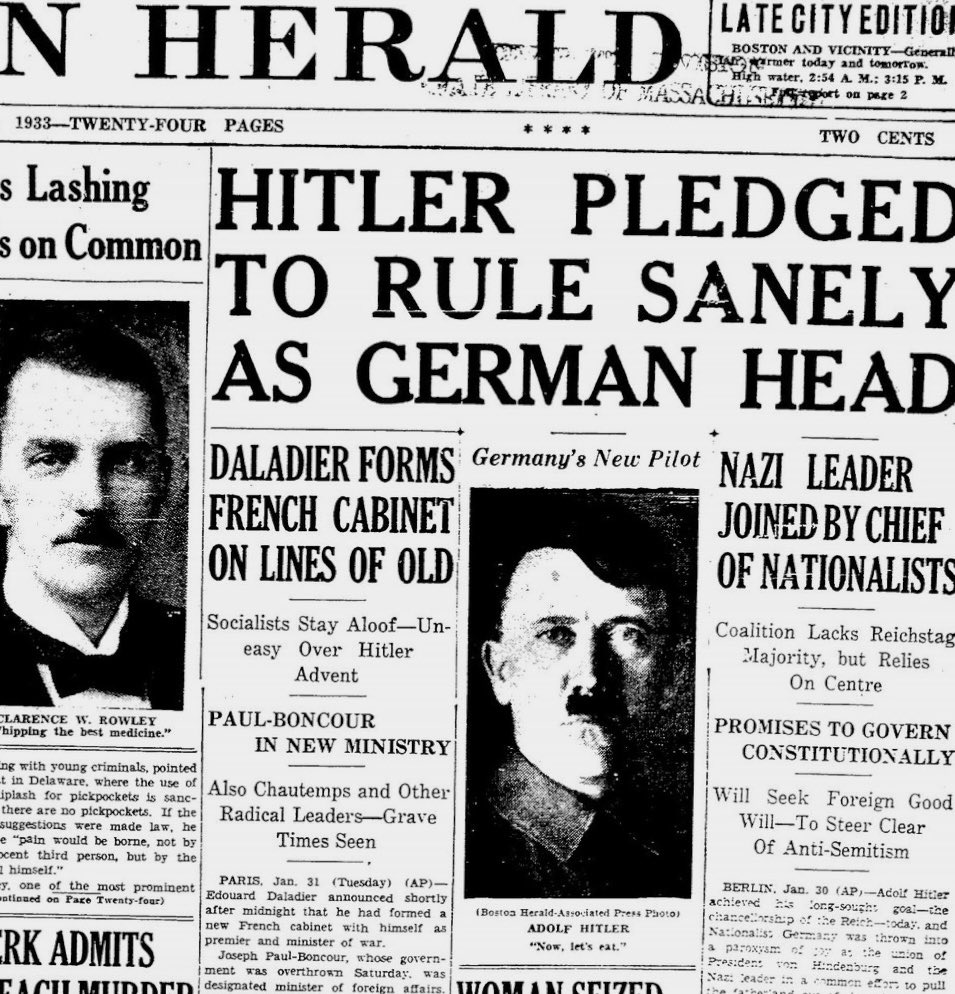
Ending Democracy From Within Hitler’s first discussion with his cabinet on January 30 was about how to create an Enabling Law to circumvent the Reichstag and let Hitler rule by decree. Conservatives were fine with that. A few days later (February 2) the cabinet adopted an emergency decree for “the protection of the German people” giving police enormous power. Two days later the cabinet adopted an emergency decree to arrest striking workers. They were moving quickly, and conservatives were pleased that they had secured the power to destroy the Left – especially the Communists. Soon it became clear that Hitler had no intention of playing by their rules. Frick, the new Nazi Minister of the Interior, replaced SPD (Social Democrat) leaders with Nazis, mandated prayer in schools, and gave the University of Jena a chair in racial sciences.
The Reichstag Fire Decree Hitler’s consolidation of power began in earnest on February 27, 1933. It was one week before the March 5 federal elections. Tension had been building and the SA brownshirts were anxious to fight their opponents, the Communists. And then, the Reichstag was set on fire. Hitler learned of the fire and was driven to the site. Like any good narcissistic leader, he was enraged and took the fire as a personal attack. Hermann Göring, suspiciously on scene (speculation remains that he ordered a paramilitary unit to set the fire), rushed over and convinced Hitler to let him team up with SA to destroy the Left. Hitler responded in fury: “Now there’s no mercy…every communist functionary will be shot where he’s found. The Communist members of the Reichstag must be hanged this very night!” It was a call for political vengeance, but the police hesitated.
Law and Order On February 28, Hitler decided to act within the constitution. He blamed the Communists for the fire and urged a ready and willing Hindenburg to use Article 48 to suspend civil liberties. The “Decree for the Protection of Volk and State.” The “Reichstag Fire Decree” enabled Hitler to suspend the constitution and curtail personal freedoms: freedom of opinion; freedom of press; and the freedom to organize and assemble. It dramatically increased state and police intervention in private life: censoring mail, listening to phones, searches without warrant. President Hindenburg approved a new legal category “protective custody” (Schutzhaft) for political dissenters. All criticism of the government was outlawed, and political ‘gossip’ was now seen as dangerous. Hitler was using legislative loopholes to destroy democracy from within. Hitler utilized the police to arrest political opponents. 4,000 political opponents were arrested that night. Within months, the police arrested more than 20,000 people in Prussia; 40,000 political opponents fled to neighboring countries; and within weeks, 25,000 were arrested and tortured in emerging “wild” concentration camps (80,000 total by end of the year). The disunified Left realized this was no longer politics, but annihilation. Special courts were introduced to speed up the process and avoid entanglements and delays.
Destroying the Legislature On March 23, Hitler moved to pass an enabling act, the “Law to Remove the Distress of the German People and the State” (a nice, cynical touch) that would transfer legislative authority from the parliament to the Reich Chancellery. To pass, it required a two-thirds majority and 66% of deputies to be present. But many ministers had been intimidated and were not present (including at least 26 SPD hiding for their lives). How to overcome this? Göring, as President of the Reichstag, simply created a new procedure deeming any absent members as “present” to ensure the “constitutionality” of the vote. The Nazis were still 31 votes short. Now what? The Nazis lobbied the remaining obstacle, the German Center Party (Catholic). Hitler promised them that he would only use his new powers in emergencies and promised the Catholic Church that they could operate without any interference. Hitler enjoyed lying to those willing to believe him. Thinking they had secured a win, the Catholic Centre Party gave the Nazis the required votes and the enabling act was passed with 441 deputies voting in favor with 94 nay votes. The Reichstag had voted itself out of power. The Enabling Act would be renewed three times in the coming years and was the pseudo-legal foundation for Hitler’s actions.
Enter, the Courts The courts, not for the first or last time, shaped and helped Hitler to consolidate his power. Justice Franz Schlegelberger, State Secretary in Ministry of Justice, played a key role. He had been an opponent of the Reichstag Fire Decree arguing that it was unconstitutional to retroactively impose the death penalty for arson on the unstable Dutch tourist the Nazis had arrested for the crime. The judge was not so concerned with the decree as much as he was concerned that it was retroactive, and thus, in his mind, illegal. This is one of the main reasons the Nazis learned to work within the system. Schlegelberger had trained during the Kaiser Reich and was attracted to the idea of an authoritarian legal order that could maintain social order. He gravitated towards Hitler and believed that individualism undermined the state’s ability to keep order. He would not challenge decisive actions by Hitler if they followed legal forms. Thus, in ruling about the legality of the Enabling Act, he embraced the pseudo-legality of the manipulation of the vote (at least they had gone through a process) and ruled that with the elimination of parliamentary oversight of legislation, the government could now act “with boldness, quickness [and] richness.”
“Working Towards the Führer” It was the cooperation from the public that made Nazi control possible. There were relatively few police per capita, and people quickly learned that all they needed to do was to obey the law, try to stay out of trouble, and promote their own interests. Werner Willikens, a bureaucrat in the Prussian Agricultural Ministry, summed it up best by saying, “…it is the duty of every single person to attempt, in the spirit of the leader, to works towards him… which would lead to enjoying “the finest reward” of “suddenly attaining the legal confirmation of his work.”
The “Night of the Long Knives” In June 1934 Hitler ordered (and was present) at the slaughter of the leaders of his paramilitary, the Brownshirts, and some of his political opponents. It was outright murder, but Hitler claimed he hadj to do this to defend the nation (from the very group he had utilized?) Hitler had decided to side with the powerful elites (Army, businessmen, bankers…) over his own thugs in order to advance his power. Is Murder Illegal? Even President Hindenburg was impressed by Hitler’s decisiveness. It was clear that no opposition to Hitler would be tolerated. On July 3, the Reich Cabinet issued a law, legalizing the murders after the fact, as an emergency action taken to save the nation. Hitler addressed the Reichstag on July 13, 1934, explaining that, as the supreme ruler of Germany, he had exercised his power against individuals who threatened the existence of the German nation. He was claiming to have acted in self-defense of the nation. Justice Schlegelberger, having already approved the Enabling Act, now accepted the idea of retroactive sanctioning of the killings as it “was absolutely justifiable, because revolt meant a state of emergency.” He had already ruled that Hitler could act with boldness. Murder was now seen as an acceptable act of the state to protect the nation.
My Turn There are echoes here about how people who despise democratic checks and balances work hard to get unchecked power. As one who believes in democracy, it is self-evident that individual power must be checked. We are not 1930s Germany. Yes, there are echoes, but also something different, bipartisan push back. An investigation into what Secretary Hegseth is up to (in our name) is a good start. Military veterans speaking up against following illegal orders show a clear difference between our system and Germany in the 1930s. We need to keep supporting those who point out the obvious – that unchecked power and greed is self-destructive and destructive. As we turn back to the 250th anniversary of our founding and the extraordinary ideas produced by imperfect people, it is important to embrace the significance of those ideals:
The Declaration of Independence: We hold these truths to be self-evident, that all men are created equal, that they are endowed by their Creator with certain unalienable Rights, that among these are Life, Liberty and the pursuit of Happiness.--That to secure these rights, Governments are instituted among Men, deriving their just powers from the consent of the governed…laying its foundation on such principles and organizing its powers in such form, as to them shall seem most likely to effect their Safety and Happiness.
Our Constitution: We the People of the United States, in Order to form a more perfect Union, establish Justice, insure domestic Tranquility, provide for the common defense, promote the general Welfare, and secure the Blessings of Liberty to ourselves and our Posterity… Our freedom, liberty, safety, and happiness are rooted in recognition of the dignity of each individual. As humans we face challenges, contradictions, motives, and rationalization that sometimes betray this.
As we look back, we can be patriots who overcome our own failings by accepting the challenge to live with law and order, not law by order.